You are not logged in. You can log in or create an account to save favorites and join collections. more info
Embracing Luminosity for Liberation


Retreat - Description of Vajra
The talk focuses on the Vajra, symbolizing the unity of the five Buddhas, their consorts, and elements of wisdom and compassion in non-duality. It explores the process of dissolution of elements at death, particularly highlighting the importance of recognizing the ground luminosity, intrinsic Buddha-nature, during death for liberation. The discussion delves into Dzogchen practices, emphasizing the need to explore beyond ordinary experiences to recognize and abide in the true nature of mind, which serves as the basis for liberation.
Referenced Works and Teachings:
- Dzogchen Teachings: Emphasizes direct experience of mind's nature and recognizing the ground luminosity, considered essential for liberation.
- Bardo Teachings: Discusses stages of dissolution in death, particularly recognizing luminosity, as described in Tibetan Buddhist texts.
- Kalachakra Tantra: Mentioned regarding the recognition of luminosity leading to liberation without an intermediary state.
- Five Wisdoms: Discusses five Buddha wisdoms, including mirror-like wisdom associated with transforming emotions like anger.
- Rigpa and Dzogchen Tantras: Concepts of self-recognition and the natural purity of mind, crucial for understanding rebirth and liberation.
The teachings underscore the practice of maintaining awareness and recognition of one’s intrinsic nature, especially at the moment of death, to achieve enlightenment and liberation.
AI Suggested Title: Embracing Luminosity for Liberation
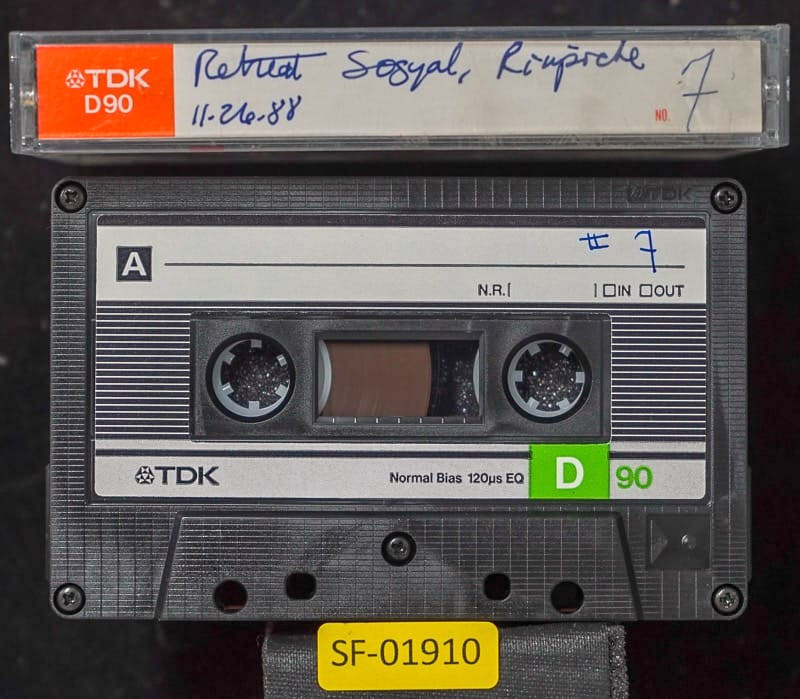
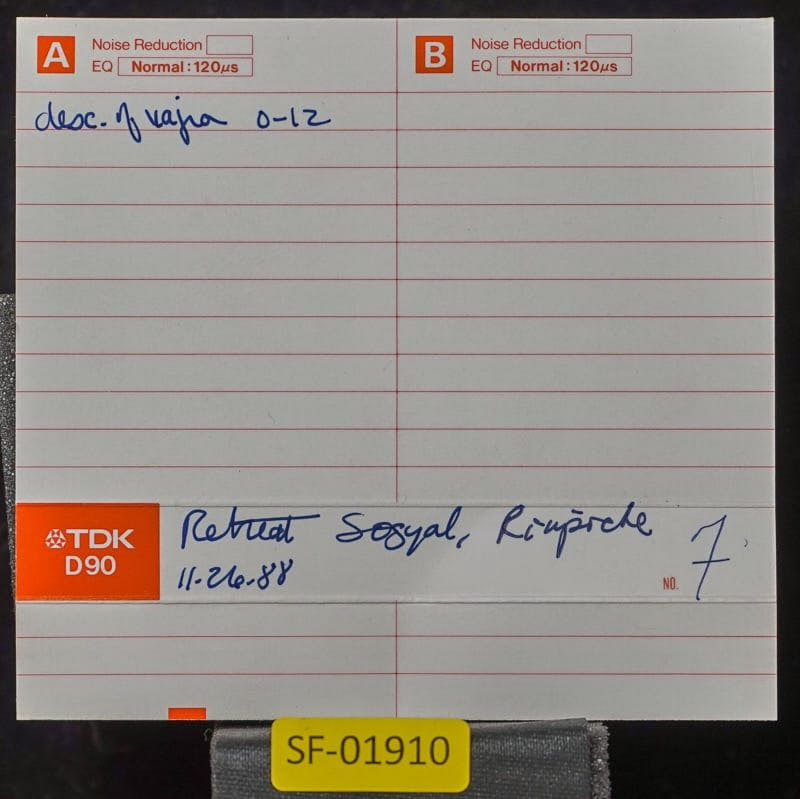
tape_1:
Side: A
Speaker: Sogyal Rinpoche
Possible Title: Retreat
Additional text: desc. Vajra 0-12
tape_2:
Side: B
Speaker: Sogyal Rinpoche
Possible Title: Retreat
Additional text:
@AI-Vision_v003
Recording starts after beginning of talk.
There's not the five standards, only four, where there's no body. What other five standards are form, body, feeling, perception, concept of consciousness, and the concept of intellect of consciousness, looking five. These are, when purified, are five different of the five to the seven. And the five negative emotions, such as anger when purified, is mirror-like wisdom. are five Buddhists. And the five feminine consorts of the five Buddhists, the five Buddhist family, are, in fact, the true nature of the element. And all which is symbolized is this Vajra. This Vajra represents the five Buddhists, the five Buddhist family, and their consorts. It is energy and the elements united by compassion to the non-duality of the Vajra nature. detailed description.
[01:09]
I think what is important for us to recognize is that that the process of death takes place then the solution of elements we need to stick here. That's it. What are some of the elements that I mentioned this morning. It is possible to treat with the right medicine or the path we must to do the person that. But then there is what is called the inner description, which is the founder's essence, the same thing, the mother's essence, the same thing at the time. When that begins happening, then it's very difficult to do it, the person that doesn't want to do it. return so that in this one when you see i think what is very important is that in this what is called in buddhism called alaya it's in sanskrit called alaya in tibetan it's called kuiji which is it is described here as the ground what's called all ground all ground i mean which is the ground of all it is like a fundamental
[02:34]
It's just the basis of mind. Like, for example, I think maybe I should explain this to you. In Dzogchen, the uniqueness of Dzogchen is that even though when you, for example, when you practice, when you practice, especially if you know when he or she practices, he or she may have a very good experience, like an experience of after the thought. or experience of bliss or experience of clarity. But that experience is not free of the cocoon or the Hadassah. It's not free, it's not going beyond the Alaya. Alaya is a bit like a glass house, you know, a glass. It's not so apparent, but nevertheless. So that's why in Dzogchen you have to explore the Alaya and go beyond the Alaya to reveal the experience. Perfect.
[04:21]
No. No. Now, to put this very simply, so that it's not too big in conclusion, but it's very simply. It is the conclusion of the desolation of heaven. In the early century it was set with the outer gesture which is needed, and the inner gesture is set.
[05:34]
That puts out the 3-chance consciousness dissolving to ERIM. I think my conscience is disorderly to iron. My conscience disorderly. You can accept the ignorance disorderly. So it's pretty true. Very simply. Can you stop? Levante. Levante. You get it? The conclusion of the feeling of the dissolution, that all aspects of mind dissolve into the state that they often have done with that.
[07:23]
then the black red dharmaka would be the manifest. Now follows the reason why the ground Luminosity manifests. And the first ground Luminosity in any way is this Buddha nature, which is good present in all Sintian people. pervades, you know, pervades them since the beginning of that, but unfortunately it's obscured by what is called emerging ignorance, or the ignorant aspect of the ARAF. So that's why the wisdom presently in oneself stands under the Ignorance. Therefore, each being is continually submerged in conclusion. since at this point even the obscuration is dissolving itself.
[08:33]
As I mentioned in this particular blur, that at the moment of death is a tremendous opportunity, one clearly understands what is happening, and is prepared well for it in life. For at the actual moment of death, the thing that evil mind dies into darkness, and it is true that I cannot expect. So since the obscuration dissolves in itself for a short while at the time of the dissolution stages, then wisdom will benefit nakedly, appearing also to ordinary people, to all alike. But the ordinary people fail to recognize, and the habitual pattern of obscuration repeats itself. It recurs again, because they are much stronger in particular, whereas And repeat itself, and again and again people continue following the rebirth and the samsarika and jodh, the existence, and jodh as an unbroken chain.
[09:41]
It's actually only a temporary interruption. But for a practitioner well acquainted with the main practice of these instructions, then the mother luminosity, which is the self-manifest, original nature, and the child of monosity, which is what has been practiced at the top, will mingle and suffocate together, and yet neat as all practice, or like a river flowing into the ocean. For this reason, liberation is easy. This is where, when I put it here, into this essence, the thinking for the actual moment of death, thinking evil-minded eyes into the essence and in this trip, a kind of gift first. See, we are familiar ourselves with the true nature of mind, to practice while we are still alive, and we become more prepared for what we are doing. It's a spontaneous state of mind.
[10:42]
Recognition then follows as naturally as a child running as much as that, remaining at this state of mind. The teacher is serving. Just the moment you get such a path that there is a real death, real break, that the ordinary, what it really does in the message is real. And in that moment, all the break, for example, like in England or somewhere, it's always a bad break. suddenly it clears, it puts a chock up. You know what I mean? And momentarily, at that moment, a pure nature commitment, which is the Buddha, it pervades also, it's there anyway, but from it obscured, that repeats.
[11:51]
That's why it's such an important moment. I think it's because of this, that in the near-death experience of the fall, of the seeing of the light, and this tremendous feat, and that the experience in the present, in the low respect. And I, in some ways, pointing to this particular fact. But also, I would like to say that, as regards to near-death experience, I think it's important to bear in mind that it is near-death. However good the experience of the may the experience may be, still... You understand? However, or rather, what is important is bear in mind, because it's very powerful insight, including that nature might hear... Now, generally in Buddhism there is this description
[12:56]
The use of the terminology works for the two luminosities. It's called the mother luminosity. Sometimes we know that the basic luminosity or the ground luminosity is the same. Because you see, mother is from, you know, the child, with every account of what the mother principle is, the view, the source. So it's very like the ground, very badly. I'm going to luminosity. And then there's also a use of what's called child luminosity, or the sudden luminosity. Now what it really means is that there is only a matter of actually, it's only using an example. An example can help us to secrete it. And what it really means is that the mother luminosity, grand luminosity, is nature of the earth. That is great. Both nature of our mind and nature of our mind. That when the obscurity is removed, if you read it there, at that moment, that's what is called grounded monosity, or modern monosity.
[14:11]
Now what is child monosity, or the sun monosity, sometimes not as part of monosity, is that a teacher, if you follow, like my colleague, not the master, you follow the practice, and the master has been introduced to you, the nature of your mind. and you have a glimpse of that. And then you have intubated through your practice, and you have a recognition. That recognition, that practice of nature-mind, the rich life, is the charlokhan. Now, when the ground luminosity presents itself, it's your, you know, the charlokhanosity, your practice or your recognition recognizes what is happening. In reality, there's no truth in it, really. It's only in some points that we're explaining we took off Magadubanast, Italian Magadubanast. But in reality, that's not true. In a sense, if you recognize the nature of your mind, what is required, which has been introduced by one's master, is that one is recognized.
[15:19]
Then, indeed, it's the merging of the two Magadubanasties. And that emergence of the two Magadubanasties is a very particular direction of enlightenment. Something about this example of the child recognition, you see, child has always a very instinctive recognition. Even how young a child is, has an instinct lost by the mother even. So it means that if you practice doing so well, if you realize the nature of your mind, then you can really integrate that. If you have an instinctive recognition, meaning when the truth, if you read it so, at the moment of death, rather, when obscuration die, when you die, it's an obscuration, an ignorance, even wisdom, so-called, everything, die. Then, at that particular, all senses, in fact, in the Tibetan version, it says, first the sense of all the, you need this sense-mind, consciousness, die, into the other air.
[16:26]
Then it's like the more negative mind, the more afflicted mind, dies into the alaya. Then it is the wisdom that dies. Then even the ignorance dies into the self. You know what I'm saying? Or rather, even the ignorance of the alaya dies into the self. And so at that moment the dharmakaya nature, the actual dharmakaya nature, the wisdom that is unstained or immaculate presence. It is also, for example, in the traditional proprietor also, Now, there is something that is interesting to bear in mind, really, a technique of being something like this, is that, like in the past, when I've taught this, I've almost never heard
[18:04]
For example, if the first experience of luminosity is more related to the first part of the moment of death. But in reality, what is important to bear in mind, the first part of the moment of death, or moment before death, or moment of death, and the part of the dark matter, merge into each other. It's not a very clear line. It's rather than what is known as the part of the moment before death. Once you have actually ceased to persist, but once you're dying, the ordinary thinking mind is dying, like at that moment, then the father's essence and mother's essence, and then learn the purism of the dark state, and then that kind of thing. At that moment, when all your aspects of your consciousness has died into the truth, into the state of Dhamma, And from out of that state comes the reading of our inner nature.
[19:10]
And the one who is very a practitioner, because for ordinary person you can just flash and you just kind of think, what was that? What was that? So in some ways that kind of a continuation of the first part, but also at the beginning of the downtime. So that is described here as the first liminal. Is it clear? Now, maybe you can stop for the feedback. First of all, I think it I want you to remind me of the point. In the Dzogchen teachings, I mean in Buddhism in general, really, and particularly in Pahar Muddha, and especially in the Dzogchen, the most important thing is introduction to the nature of your mind.
[20:23]
Now, Dzogchen, I mean, in Dzogchen, There is a difference in relation to the nature of your mind. There are many, many aspects of mind, but generally speaking, we use two terms. One term is known as, for example, mind, or the sense, which is the thinking of one. But then, that's the ordinary mind. It affects the cloud, let them know. But beyond that cloud, that the intrinsic pure works of our inner and wisdom, let's say, aspect of the mind.
[21:27]
In general, in Dzogchen, we don't use the word mind at all. Mind is more repetitive. Now, what has died is all the aspects of a confused mind. That has all died. But what have you seen? What I want to really say is that so that in a pain reduction by the Master, one must have a really direct experience.
[22:37]
Direct experience. It's not sufficient to have just an intellectual knowledge, but really a direct experience of the teaching. Once you have the direct experience, direct views, direct experience of the And then that's what you actually abide by that view of recognition. In Dzogchen, the meditation is nothing but abiding by the recognition. And then with that understanding, you try to actually apply it in your life and being about liberation. So this recognition or this rig part is very crucial because it is that which recognizes. when one has, for example, ethics here. Now, also what is important is that this aspect of life, or this fundamental nature of your mind, or the ritual, has what is called the five aspects, among the five Buddha wisdoms, three kinds of five wisdoms.
[23:49]
One of them, the most of the five, it is the quality of all the encompassing of space, known as the wisdom of Dhammedha, all encompassed at the sky. It is also very clear, like the mirror. Like if you use the example of the mirror, mirror is very open and spacious, that mirror like reflected wisdom of Dhammedha. It can affect everything that is visible. That's what mirrors are with this mirror like this. And that mirror reflects everything. Good energy. There's no, how to say, bias, no judging. It's called wisdom of equality. At the same time, it does not, it sees everything very distinctly. It does not mistake the beautiful thought of it. In the end of this, no bias, but it sees everything distinctly that God has to come. Distability of it. And finally, everything in the middle, like everything is responding, is coming.
[24:55]
You don't have to greatly You don't have to draw it, it is there, as soon as, you know, as close to what's all accomplished. But these five bring me into a purpose of explanation. We have to speak that the distinctly is five, but in action, in the state that was the mind, that all these five are one, there's no life separation. You understand? Now, and in this respect, that even though the nature we find is empty, or even though when we die, for example, like the mind dies, ordinary mind dies, that the discriminating awareness aspect of the wisdom mind discerns it. For example, it is said in the teachings that even though the nature of your mind is empty, but then the question comes, who relies? Who relies on this? It is the discriminating awareness of itself recognition. Oh, it's self recognition. It's self recognition. But it's not so easy to just jump to self-recognition to a text kind of, as you say, coming to a too quick conclusion.
[26:02]
Otherwise, I could have said to you from very beginning to self-recognition, but it's not enough. You've got to go through the long-winded experience, understanding self-recognition. And so there is an aspect. in a state of that wisdom exceeds itself. Not difficult questions tonight, please. I have a similar concern, Mr. Chair. The ability that I believe I have now, I could try to discriminate that. Realistically, when I'm dying, there'll probably come a point when I get confused and frightened and freak out.
[27:06]
And I'm certainly not capable of doing that. That's what I hear your question. That's what the reason is that I think that sometimes the tendency, I think generally, I'm not with you, but what I'm saying, generally I find sometimes the tendency among people who do not have, for example, the, who do not have the spiritual culture, who do not have the basic awareness, or the understanding of the Taoist, for example, that immediately that when you come, like I said, somebody comes to you, just drops back, because you drink, Like I said, very much. But it kind of pushes many buttons. And then they begin to say, I can't help it. Too much to go. And then leave it.
[28:07]
That's a very example of how interesting. Not telling parents that. What is the important bit? Not to take things to person. And secondly, you see, it is because you have these fears that fly you. Because if you have a fear, if you have a fear that you want to get, you want to lose your fear. It's not just, if there is a fear, if you run away, you kill that all the time. So, but there's a way of doing it. You don't need to come from the fear directly, but you can just be gentle. with yourself. So in the same manner, like for example, if you feel that there are, that you need to see a feeling, that's something you really care.
[29:08]
There are aspects of this teaching which extremely encourage you, but there are also aspects that are rather effective. So I think it's where ever it's confronting and it's that not so kind in it. And he teaches us that we need to work. And whenever it encourages him actually, like here's a story of an old woman in Tibet, the story who's in jail from the streets, and she came to, there was a helmet in Tibet who was, who spread all his life methods. and meditating. Then one day he thought, what, you know, just had a bit of a job. He said, well, I don't think I have to stay here all the time and take a practice. So I should go teach. So he came and gave him. And in teaching there are all these aspects, both encouraging aspects and also being... So at the end of his teaching, one woman got up from there, one old woman got up from the crowd and said to this guy,
[30:19]
But, well, when you talk about the wonderful qualities of how powerful the Dharma is, how incredible the power is, that it kind of gives me so much encouragement and I feel that not only you, Lama, but even for me, old woman, there is some hope. But when I start hearing about all the negative karma and all these different things, I realize that there's no hope. Along me, I think even for you, Lamas, maybe. Not us. Really. So you need to kind of balance it out of there. Balance it out of there. Okay. Very interesting. So what all schools, both the yin man and the salman, agree that this ground luminosity or this mother luminosity, the ground luminosity, is the basis of liberation.
[31:47]
And it is of the ultimate dhammaka as this. Basically it means, you know, that's the stuff that you get in mind. Because in that state you get in mind. That's correct. This is the most fruitful moment. This is it. You know what I mean? It says here, moreover, since most people fail to recognize the ground room philosophy, although it manifests for them, and although they do not... See, moreover, since most people fail to recognize the ground room philosophy, although it manifests for them, or although they do recognize it, they are not sufficiently acquainted with it. not able to remain in its continuity. Apart from that, there is no doubt that it is the true ground of depression.
[32:55]
You see, one thing is that because they are not familiar, it's as good as not appearing. Or it may appear, but they cannot sustain it. You know what I mean? If there is a very famous quote from Dzogchen Shinge, from that it says, this is a good one to quote. It says here, the nature of the mind of all Buddhas pervades all such beings naturally since the beginning. When this secret awareness, that means Brikpa, is manifest in the field of experience, it manifests five lights in the manner of mother-child-mitment. When the child manifests dissolve into the mother, all the spare juristic mind are cleared away. The doubt of confused thoughts and statements get cut, and the illumination of the wisdom sunlight completely disperses of all conceptual things.
[34:05]
By the power of being free from the doubt of the conceptual kingdom, awareness wisdom that is required will be strengthened. and will rest accordingly in a state of non-help. And the non-help, the unmanifest wisdom will perceive everything. When the fruit of sacred mantras fully ripen, the wisdom of Rigpa cannot help but manifest. At that time, one's awareness of Rigpa, having awakened the essence of procuring perceptions, is apnecure. The nature of wisdom, the void of word, is experienced and the genuine manifestation of the secret mantra of the sin. When not engaging in the cognition of is and is not, Samadhi would be achieved in five days. Last one. The famous tantra which I quoted to you, remember? This is one of the most important doctrine.
[35:13]
Name of one of the 18 Dzogchen Tantra, what is called Vangha, [...] Self-rising, self-liberation, the expanse of non-horising. Spontaneous presence dissolved in the space of primordial purity. Free from the extremes of hope and fear, the limit to both cause and effect having ceased. Space and awareness without duality, our freedom to primordial purity, the spontaneous great perfection of non-existence. And also, moreover, according to the Kalachakra Uttat, it says, when recognizing this luminosity, one will definitely be with no intermediary state, in no part like that, deliberate from the all-suffering.
[36:28]
Also, it is stated in the Nimenamite, the person who has recognized this luminosity will not see the serial department, the clearance of the room, any of that people. Unfortunately, you see, In the translation, it's very difficult, like to example from Nidakhati. You see, I mean, what is Nidakhati? Can you read this Nidakhati? And I will read it from Tibetan, page 83. Therefore, being untainted, it is sufficient. It basically means that because it's untainted, therefore, it's sufficient. Because it's not sure that it's sufficient. Meaning, therefore, it's clear.
[37:29]
The sky is not tainted, then it's clear. In the translation here says, Self-liberation, the expense of non-arising. It doesn't really say it. Self-rising means self-rising. It rises itself and liberates itself. And from out of the expense of unborn. Because in this state, it rises itself and liberates itself. It's very much a doctrine terminal. And from out of this unborn, meaning Anything that is born, anything that is created is subject to impermanence. This particular state is beyond birth, therefore beyond death, therefore uncreated. But yet everything is spontaneously accomplished in this depth of the great, in the vast expanse of this primordial period.
[38:31]
In this state there is neither hope nor fear, neither doubt nor fear. The United need to confirm there is three of all these extremities and also three of the cause and effect. Because cause and effect, there is no justice. This is the, in this state of what is called, in this state of the indivisibility of the Rekpa and the Dhammada, all encompassing the Rekpa, the indivisibility of sleep. is the liberation of the primordial purity. And she had mentioned, though, in the state of Djokov temple, which is beyond any effort of abandoning or adopting, that everything into spontaneity is accomplished, sometimes. That's the meaning of this. This, unfortunately, in the translations, it doesn't really help state. It doesn't really, like a joke inside the French flag.
[39:32]
Because the language is so rich. You see, the typical transits from a non-European language to the European language. Make that kind of jump. Because conceptually, you know, there's no very concept. And when you have a transits, it becomes just many, many words. So it becomes rather uncomfortable to have it. Unfortunately, it has kind of a disservice. But it can help because there are difficult transits. So basically it means, what all this is pointing to is that particular state. Basically it's saying, it's confirmed with the fact that we experience the ground luminosity is the basis of inner. That's where one's inner nature, Buddha nature is pervades only, that Buddha nature is where all our thinking, the illusion aspect of being, delusion, ego, all this time, what you reveal is your ability.
[40:41]
At that moment, if you have the recognition, you have the recognition. That is when, I mean, it's not in a saying, well, okay, if I'm a Buddha, then it's sufficient. Even though it arises, but the recognition is there. That's where the difference when you are liberates, if you recognize. You might be a Buddha, if you don't recognize it. You may push on it, but this is where he says, in an instant, that you say, enlightenment, in the instant, but be confused. So that's where But try to stick in mind that the moment of death should be very, the mind must be destroyed or that's one of the reasons why any weeping or any emotional pain must be done prior.
[41:43]
So that when the person actually, the moment of death, should be filled with any emotional pain. Emotional distress. Let's go down. when he says there should be no weeping or this, what it really means is that, it doesn't mean that, you know, you need to believe in God. No, no should be gospel. There's a grave among us, it should be peaceful for us. If you are in a good state of life, there's a recognition for you. This is the most important. And this is something that is practical. I mean, all the different, you know, we're not still in the original that are rather difficult for us to have you on. In whatever you are talking about, this is what you can do. This is not Christian. Now comes the very interesting part, which is also a little difficult, but however, we must do it too.
[42:57]
There is no escape. Having explained the general system, there is a further twofold division. The Dhammakaya luminosity of Pramodjo Kiritri, which in Tibetan it means Kadar Chukyesa, and the Samlokaya luminosity. You must make a distinction according to the system, of the instruction section meaning, according to the Dzogchen Upadesha, Dzogchen teaching is a three-second, which is called assembly, category of mind. Inner is long in the category of space, and the secret is what is called Upadesha, or Manga, the category of fifth instruction. According to Upadesha, and according to the innermost annexed cycle of nigdi, that's like the longchin nigdi, according to this is the vizhila vigila.
[44:01]
Vizhila is the is deduction and instruction according to Wong Shun Jing Di. Now, there's a division of knowledge according to that. According to that, then you see the first is exactly the ground luminosity, the natural state which manifests like a pure cloudless sky. Same. So, it one recognizes Wong's nature. Here, in the very next recognition, one will appear in enlightenment in the great original state of the and will therefore be free from the latter residual manifestation, meaning there are no other manifestation. That's it. But if however one is only slightly quantitatively stable, and thus unable to be liberated, then the inner breath will cease and the red element will emerge from the right nostril in the form of blood or limb, and the white element will emerge from the secret part.
[45:09]
At the same time, one's awareness, like a spark fading, will emerge from any of the apertures, such as the eyes, and the part of dharmata will manifest. This is called dharmakariluminosity of the Pramodipi. If one is not liberate at this point, then at the end of the space dissolves into luminosity. The so-called luminosity dissolves into unity of terms. Now this is Kishida. In Dzogchen, he said, Mind is all into?
[46:10]
Space. Mind is consciousness. Mind is consciousness. How are you going to say that? Into? Space. [...] slightly acquainted with this state, and thus unable to be liberated.
[47:20]
Then the inner breath will cease, and the red element will emerge from the right nostril in the form of blood or lymph, and the white element will emerge from the secret path. At the same time, one's awareness, like a spark fading, will emerge from any one of the apertures, such as the eyes, and the bard of dharmatta will manifest. This is called... This is called the dharmataya luminosity of primordial purity. If one is not liberated at this point, then, at the end of space dissolving in luminosity, the so-called luminosity dissolving in unity occurs. At this instant, the rascal Haruka deities will reveal themselves in all their attires and attributes with numerous heads wearing various ornaments filling the entire world. The spontaneous sound of dharmata will roar like a thousands of thunderclaps and the colors and lights will ignite like a hailstorm of weapons.
[48:28]
Amidst this immense terror without recognizing one's essence one becomes now panic-stricken and faints. When regaining consciousness the above is all completely vanished and the peaceful deities gradually manifest. Then all perceived objects, such as earth, stones, mountains, and rocks, totally devoid of materiality, are of the nature of rainbow light, completely clear and shining. Vast and free from obstruction, brilliant and magnificent, they manifest with a nature that totally transcends all limitations. At this point, one will think that one has the body of one's former life. Completely pervading the space in all directions, above and below, countless rainbow lights in the form of five colored spears manifest. And within each of them are the innumerable peaceful deities of Vajradhati, such as the five families of Victorious Ones, the male and female Bodhisattvas, all with wonderful expressions and attire captivating to behold.
[49:32]
Extremely fine rays of light extend from each of their heart centers and connect to one's own. All of these manifestations are completely ordered. From the rays connected to one's heart, Countless fine spheres will also be seen to emanate. Later, one experiences all of these forms dissolving into oneself. After that appears the so-called unity dissolving into wisdom. From one's heart center and into the space above, blue, white, yellow and red lights shine forth one above the other like extended banners. Each is adorned with spheres of light in their corresponding colors, each of which is again decorated with five smaller spheres. Like a parasol of peacock feathers, they appear splendidly above oneself in the full five colors. All this is called the inner path of Vajrasattva. It is the light path of the four wisdoms combined. That the green light path does not appear is due to the lack of all accomplishing wisdom, because one hasn't perfected the power of practice.
[50:37]
Following that appears the wisdom dissolving into the Vidyadhara of spontaneous presence. You know what? Into? Into the Vidyadhara. Vidyadhara. Vidyadhara. The American people, they quote, they quote, it was a Vidyadhara, Vidyadhara. The American people pronounce it G-H. How do you pronounce it? Dharna? Dharna. Dharna. Dharna. of spontaneous presence, the previously mentioned Vidyadhara. Following that appears the wisdom dissolving into the Vidyadhara of spontaneous presence. The previously mentioned manifestations of light dissolve into the parasol-like five lights above. Next, everywhere above this personal phenomena, The Dharmakaya display will manifest like a cloudless sky, symbolizing the awareness and emptiness of primordial purity.
[51:45]
In between will manifest the rupakaya of spontaneous presence, the realms of the peaceful and wrathful ones, as well as the different natural mnemonikaya realms. Below will appear scenes of the impure worlds of the six classes of beings. All of this manifests simultaneously with vivid clarity, like an image appearing in a mirror. At this point, it is the nature of things that the person will automatically have the five super-knowledges, the six recollections, perfect recall, as well as continuous samadhi. Moreover, it is also taught that innumerable Dharma teachings, previously known as well as unknown, will arise within one's mind. In short, liberation is assured if one remembers at this appropriate time the vital points of the oral instructions, whichever have been taught, and puts them into practice. But if the power of one's practice is feeble and one is not liberated, one will for a while see the dream appearances of the bardo becoming, and then doubtlessly pass on to a natural mnemonic eye around.
[52:50]
To traverse all the paths in the room, it is thought that one will attain enlightenment. This is a very good practice. This is very important. Very wonderful. Unfortunately, it's quite short, so you can tap that. So everybody can have a couple of pieces. Now, you can let me read it. How to bring the bardo of dharmatal into the past. Dharma. [...] Dhammatologi. Not Dhammatologi. Dhammatologi. Dhamma. [...]
[53:55]
Dhamma. [...] What is the duration from the initial bardo of dying until this point? It seems because of the words used and the intervals and the duration of all that transpires that these bardo stages appear for a long time, whereas in fact they don't last very long. In the first place, given the different Nadi constitutions and the circumstances of individuals and their illnesses, Generalizing about the outer and inner dissolution stages is indeed impossible. Most often, however, stages quickly pass. In particular, it is taught that the whiteness, redness and blackness last no longer than one instant of completed action. When, after that, the dharmakaya luminosity of death, the co-emerging wisdom dawns, it does not usually last longer than a finger snap for ordinary people who have not practiced.
[54:58]
Some can stay for the duration of a meal. Also, people who have slightly practiced can remain for as long as they once could retain stability in the practice of meditation. That is called a meditation day. It is thought that one remains in this luminosity for between one to five such days. Practitioners possessing the confidence of realization are able to remain in composure in that state of luminosity for as long as they wish. At the end, for such people, The wisdom wind will dispatch awareness through the crown of the head, and they will attain the great upper directness. This is indicated by the white bodhicitta appearing at the crown of the head, or the left nostril, when the vital point of the wisdom mind moves in the left channel. During a successful poa, the bodhicitta appears in this way. Without this sign, claims to a successful poa are doubtful. Some learned in an accomplished master, such as Jamang Pazan Zangpo, have stated that those who remain for a long time before their consciousness leaves the body are not necessarily resting in perfect meditation, as there are some people who remain due to attachment to their bodies.
[56:09]
In any case, for people of any of the three capacities, it is totally inappropriate to cremate and perform purification rituals for the body, as long as the red and white essences have not emerged from either above... Have not emerged from either... as long as the white and red essences have not emerged from either above or below. Why is this? The cremation will be an obstacle for those remaining in meditation, and an ordinary person attached to his body will be burned alive. Now, as for the luminosity manifestations of spontaneous presence according to Dzogchen, those who are only slightly advanced in practice will experience them for one to five meditation days corresponding to their degree of familiarity. For those who are not so acquainted, they will last not longer than an instant of completed action and are therefore difficult to recognize. Some, by failing to recognize the sounds, colors, and lights as their own personal experience, become terrified and faint.
[57:11]
Having described the additional points, now comes the main part of the chapter. The supreme method for recognizing the ground luminosity of the first bardo and attaining liberation is, right now in the bardo of the present life, to become fully resolved about the mind, and then to exclusively concentrate, beyond meditation and distraction, on continuous practice of the ultimate nature of ordinary mind, the unfabricated and natural state of Dharmakayan. ...maintain it, unspoiled by the obstacles of defects or the defilements, mental constructs and perturbations... I was told in the last days of Churkin from Wilmington, he said, Elocution of Gladys. That was his final teaching. It's crucial not only in the first part, but at all times.
[58:14]
Liberation, drearyings, you know, the turtle and so forth. essence, deciding on one thing. The third one, the directions are made to be made. And the third one, at today's point, after resolving the names of the six land, making the base of three-fold motionlessness, keeping the measure of the three-fold attainment, planting the stake of three-fold attainment, ensuring the degree of liberation through the four-fold conflict. When one not letting these and other points remain as mere rhetoric, applies that meaning to one's being, one will perfect the four visions, and in the best instance, liberate the physical body into the unconditional body of life. As the next best, one will obtain stability in the ground monocity, just like the space within and outside a vase mingled together when the vase breaks.
[59:22]
And thus, just like a lion coming out of the enclosure of the womb, or Garuda leaving the enclosure of the eggshell, one's mind detains Dharmakaya simultaneously with being freed from the enclosure of the physical body of karmic rightness. As the third best, when the spontaneously present luminosity of the lucrofayas manifest in the power of Dharmakta, it is of the utmost importance to possess the key point of knowing how to enter at the time of luminosity dissolving into humans. The key point of the liberated body at the time of junior development, and the key point of graphic art, perfection, have done the wisdom story with Vicky D'Art, rather than the spontaneity. Concerning this time of spontaneous presence, the town for states, as for how the spontaneously presently ran, It manifests at eight times of gates.
[60:31]
According to this statement, the expression of awareness itself is manifested as compassion, manifest as light, manifest as bodies, manifest as wisdom, manifest as non-duality, manifest as freedom from extremes, manifest as the impure gate of samsara, and manifest as the pure gate of wisdom. When these gates are embraced by the oral instructions, there will also be eight modes of dissolution. By compassion dissolving, samsaric sentient beings are liberated as personal experience, and thus there is not even a hint of confusion. Likewise, by the light dissolving, there is one taste as dharmadhatu, which is not made of conceptual colors and so forth, having phenomenons. By the body's dissolving, there is purity as complete as the essence that transcends the elaborations of heads and arms. As long as this material body has not been abandoned, the enlightened qualities will not manifest.
[61:43]
As for instance, a Gerudo burdling within its egg may have developed its full wing feathers but it cannot fly before hatching. The ache breaking open and the ability to fly then occur simultaneously. Similarly, the qualities of Buddhahood also are not manifest at present that are veiled by the body. As soon as the body of karmic rigidity is discarded, the enlightened qualities will be manifest. As Gong Patigdeb also states, if one possesses the great confidence in realization, just as a lion reaches far in one leap, Through the great openness of wisdom there will be no bardo and in one instant one will attain enlightenment in the precious sphere. As for the measure of liberation, the union of sun and moon conscious says, there are three levels of capacity. The foremost will be liberated in three instants. The mediocre can be liberated in five meditation days or will definitely attain stability in 21 instants. Those of the lowest capacity will be confirmed in going to a natural mnemonica realm and will attain enlightenment without further bother.
[62:50]
This chiefly depends on one's present practice. Thank you. The reason I went through it once, at least you hear it, and you're probably dreaming. And tomorrow I think you'll be able. Professor? What's the practice of light and dark? Light and dark. I need to look at the text, but it could be that in the third order you're using the light practice. And it's also the dark practice. The doctrine is used. Eye is the most important. Eye, in total. Eye is the vehicle. So those of you who wanted to ask, who wanted to do tonight?
[64:04]
And who wants to do tomorrow? Eight o'clock. So those of you who wanted to do tomorrow? Eight o'clock. Eight o'clock. But openly tell you is that you have plenty of time to sleep. Just from now, if you sleep from 12 to 8 o'clock, hang out in bed. Especially if you are too late to the afternoon, you'll be much awake in the afternoon set. Tomorrow, I would like everybody to be awake. Otherwise, I should apply the visual method. Which is what? Either sprinting water in the form of evolution, or a deck of me work with buckets.
[65:13]
I have to pick some more directly together. Can we just talk about Bridget Barber? It's not now, it's no longer Bridget Barber. Do you know who is it now? Catherine? The first statue is... She's become the embodiment of France. I'm proud of becoming that people need to understand a little bit more. Because this gives much more substance, much more detail, which is very good. Our eye is actually a story. We have sometimes a tendency to have, you know, lice.
[66:13]
I think it's very interesting to present all of this possibility. It was very important not to just talk and be pleasant with us. This is a special I'm hearing for Charles. He wanted to be born as a god, a pale white light path with fear. Similarly for the daily gods, red is fear, blue for the human, green for the animal, pale yellow for the Thakuvikyo. And he wanted the carbon to be born in the cells, It is said that one would not have remained in this place not before. Do not listen.
[67:14]
This thing is called the next discussion. Can I just say anything? [...] And then also, it is said that in the practice of adoption to limit, there are certain exercises to feel about it. It's feel about a certain condition in our life, in our history, in our history. In fact, some of them are said to be also feel about it in the future. In fact, when we work with occupational illness, it will be expired. Okay. Awareness here by the means that the rest of the people. It won back such a property. You know, that's what they'll do in the Tibetan book of the day. They said, you should think of your master.
[68:15]
And Tibetan book of the day, the worst, said, normally I, I think that one out. You know, normally, you know. He said, now when the father of the coming doctor, I was fostering my mind one thought, please. He strapped the throne of the results of the wood camera, closed the wood entrance, and feel the resistance. This is the time when he persecuted his daughter in the lead. that they're in jealousy based on the world. Anything that might reduce the doubt of the purity in the mind of people, that must be seen. Because there's a secret meaning. If you don't know the meaning, then people might misunderstand instead of producing. That's one of the reasons I also said to people, don't wear balas around the neck. Or display dynamic themes around where you go. Because in the sixth stage, it's all right. At eighth stage, no. Really, just the ordinary effect. Because if you see it on the mirror, the energy to dissolve.
[69:20]
That's a root for some colors. Also, don't display too little labels and things on your car and the skin. And you look to show down the outside. Unless in the community where people by seeing that they had a reverend, so, you know, they could listen. You read the script. Like, for example, being a fellow, nobody knows that they would think of the Japanese people. Sacred. These things are sacred. They don't want to strike me. They don't want to strike me. Unfortunately, there's one, how'd you say? One, one negative. One, one quote of the Nirmaka in India. They are not really good yogis, but they do with all the yuri tools.
[70:27]
Yuri tools and drums and kind of... But they don't scare anybody, but you know... And that's why they get a better reputation, not the speed. They don't, and they, in their conduct, they act really necessary. They don't act, they don't, they play all the drums. That's what also said, if not so, I'm going to stop, and you remember, you stop. That's why sometimes I notice some Westerners who go to India, meet among so-called Inma yogurts. I become more eccentric than the Tibetans. So... What? Actually, you can get the book. Okay, look. There's Ken.
[71:27]
He's right here. Actually, he's going to be responsible for this interview. He's going to be responsible for this interview. And later on, you can get this book and you can read it. But also, once you hear it, even if you don't need to hear so much, get something like a register in your mind. It's very interesting. But if you hear something, then maybe in the part where your mind is light and still, you might remember something. Okay? You have to get to your mind. You have to make believe. But also by the... Especially when we don't understand, we pray strongly that we have to do this completely. May the appropriate action, appropriate to arrive at the appropriate time. And also, may you die in Buddha, may you die not in pain, may you die with your friends, with your family brothers and sisters, in the presence of one in us.
[72:34]
It didn't do that. For example, there was a very great master. He came. He was, I'm told you, he came in front of the very famous, he made it, the statue of Buddha. It's the most Polish image of Buddha in Tibet. And he came, and he was saying this particular prayer. He said to be the king of all the prayer, that's the tradition thing, for example, to it. And he came to a park where he says, Ngungo, Thank you. There are six liberations.
[73:37]
Liberation upon hearing, liberation upon tasting, liberation upon touching, liberation upon remembering, and liberation upon seeing. In fact, there are certain objects, there are . It's like you can cultivate many great norms that they can practice and actually develop. Like, for example, Now, if you ever go to the poor Kathmandu, if you ever go to Kathmandu, don't forget to see it. If you proceed, we won't listen to you. But also if he's not there, don't forget. Look at his temple. In his temple, in the temple as you enter, right as you from the main door enter, is this image of what he started.
[74:46]
In the same silver frame. And what he has done, he did hundred thousand hands there. Hundred, no, hundred million. Hundred million. Hundred silver marks, not all that. all these monks and bless this. This has been done with all the traditions of it. Anybody who sees this is liberated that I want to see. So see that, okay? And also when you see like the thing what comes in the table, it is a very simple thing. Like the dream of the table, it is a very simple thing. And then liberation upon tasting is there are other substance but many called amret which I always give to you. In this amret that I have is gathered, made by Jujimura Kimsa and my Rastujama, gathered all to you.
[75:53]
This is what you do. Normally it's given to you. Then there is also a special Blessed, what it's called. It's actually made of sand, but it's blessed by the master with like the many . And if someone is dead, normally they throw the . Then also there's a particular . But there's a particular . Which is this one. This is more the, this one. Liberation from . This is normally placed on the body. But also, if you don't have anything, this is enough. But otherwise, generally, not only this photograph is printed, but also the Lama must actually purchase through the practicing and power. And then, so, liberation of our remembering is the four. Liberation of our remembering is the four. So the substance four is coming up.
[76:54]
Is it good? Okay? In only one particular. Next year. It could be next year. This year we didn't do it. I mean, this year I'm going there anyway. And in fact, last year we did a big trip to India. It's about 100 people. But this year I'm going there anyway in December. And it could be. And in February, if you want to come, I won't be in fact, not yet. There is some plan to do in the future. But I won't be there in February for the last two weeks. But what I mean is next year, we might cancel what you plan to do. It might be in South England.
[77:56]
Two places next to it. Next, it's by the previous. South India, because in the small spot, the opening of the Doxin Monastery. And there, the opening of the Doxin Monastery. In fact, the Doxin Monastery was drilled because of the Doxin Monastery. So he can't listen and look at me. It's really happy. In fact, right away, he knows that Ritka has really supported that. He's very grateful for that. He supported me too. And he came there and he said, ah, I think I can eat you. Next year we can start doing teaching. So, right next year, he's going to give a series of environmental teachings of a lecture. One of the divisions of the fifth variant. Because, though he is the Karanama, he is all the Karanama, but he is most close to the fifth Karanama and the third time. And the team of the two Dalai Lamas played the strongest connection in the world with Dzogchen.
[79:03]
The fifth Dalai Lamas' personal teacher was Milym Kerdda, Milym Pershi. We create Dzogchen. And 13 Dalai Lamas teacher was 7th and 4th. And fifth Dalai Lamas' connection with the old Dzogchen was Dzogchen. Dzogchen. And it was the sixth Dalai Lamas who gained Anyway, so, in fact, it is said, you know, really, it is said that a Thongkha-ma-chen-bo, it is said that Thongkha-ma-chen-bo actually appeared, a doctrine which is said to be also Thongkha-ma-chen-bo. Thongkha-ma-che-bo appeared to work in Nyingatachi. We've been the great master in the past, then we could try to work to win genetically among different spirits. Anyway, so that might be that it could be the opening of that monster mixture.
[80:07]
Like Ivan, let me know, we do know about this spirit in the habitat. We only go to December. And then also, during that time, I'd like to make it quickly. But what I'm saying is that it's very good. If you go on your own, it's very good. It's in the Buddha, near the place where Buddha became enlightened. There you get a little candle and the light, write the name of the deceased person and then burn it. And then, of course, the best thing is to give the name of the deceased. Now, since I've been working in the field of death and dying, I always encourage people of relatives and friends to give them names.
[81:10]
So the names are collected, and famously, I published a few of the great documents, that is Vigilante and Kermit. Now, since Vigilante has passed away, It would be international money, international money already, or post check. But the best thing is to stand in my name that he was trying to be very good. One day I was very interested in him. And I offered several people to name him. Also, one of them was that somebody who was living, who was ill, right? So back to him, he took this and he kind of, you know what you said, right in the red.
[82:19]
And then I took on this with me. But it's not there. Black and young people have people. Sometimes I've got people living people, maybe, also. Because when he does the purification of death, for the living, you've been through it. So sometimes monks, they're very specific ways. Sometimes very important. It's like kind of a very extraordinary way. Sometimes they do something quite extraordinary. And that's very important. Like that type. He was a very badass scientist. If you ask him to do divinesh me what you think of me, it's not really... I mean, it won't work, you know. When you ask him to do divinesh me, he doesn't do anything, he just ferrits me. At that time, he did it. I was his nephew. He said he'd pull this in and he'd come over very early in my life.
[83:21]
He'd like six o'clock until he did this. I think it's like, you know, and you hit my head. And he always used to say, there's a combat expression. I don't know if I can't. You hit my head. What are you out of the street? And I said, again, you know, I would ask him. I would ask him questions. Did I eat this? Did I eat this? Did I eat this? Did you not answer that? You know something to do? You just check it. And you just... That's going to be real. And the gentleman said, he would actually... Of no reason, he would ask you a question. He would ask you a question, and he would say, why is it right? No, don't, [...] don't.
[84:24]
But if he can't, don't get to some reason. He would ask you a question separately. What is also extraordinary about them is that they are all enlightened beings, so they are extraordinarily different. And it is very wonderful to see that how enlightened people have different, you know, different individuals and different people. and the pitch will be a completely different style. It's extremely elegant poetry. To sit there and just pull back a little bit of poetry. The gentleman in his teaching is kind of like speaking to something. But his writing is incredible.
[85:27]
His poetry is like what he wants to do. It's incredible. That's why there's so much respect for deliverance by all I know, because of the work that we have done. It's incredible. You know, bearing and realization. That goes down to falling the line of everything. And if you look at just the words, in Tibetan, maybe in English, even in English translation, it's not so bad. So that comes, it's pure, it's not really. And this translation of that is done right. So that's why it's the natural part that we like.
[86:29]
Painter part of dying, luminous part of darmata, and carbonate part of... Is he able to... Please open the door. As I mentioned this morning, one of the most important and crucial things in the part of the coming is remembering the good things. Remembering or continuing the good kind. So I try to strive along the result of the kind.
[87:30]
good at him. Like for example, if you have a tendency, immediately whenever some difficulty or some fearful or some, you know, immediately if you react to say, if you have that kind of natural instinct to do that, that might itself may say that kind of You can. Tibetans have always, like I think, they always say whenever they have a name, [...] So, my master's monastery was on a hill.
[88:38]
He had come and crossed a little river. And the river was quite small at that time, so he could walk across. He wants to know master, stay there for a few days, and your neighbors do all the streets. Now, upon returning home, what had happened is that he turned his brain in the water. He was swollen up. Because he was able to cross, but when he thought that he would be okay, and he crossed. When he was in the middle of the street, he carried it up very strong. He was strapped into the window. Immediately, he just called up, young man, he should look into it. Please look, can we call up my master's head? Call up, and he was just taken by the ring. He was drowning. He called up my master's head. At that moment, he had a flash of my master's head. Flash of my master's head. and the smell of it. It reminds me of the incredible music. Not order. Order is bad. It's called the scent of .
[89:40]
In fact, there's a discipline in the teaching, he said that discipline is like the perfume that you need, and that the perfume of this. It's quite incredible. It stayed with my master's clothes for two or three years after he died. It's quite difficult. When you came into his presence, the smell would pervade. And when you come into the smell, in fact, in a state of mind, it's kind of, there's a joyful presence. It's something that looks incredible. That's something very, my master is something extraordinary to think about. What about that smell? At that moment, he had a very strong scent of my master, and a flash of me. And what happened? He told a vague thing, and just took him, just spread the conversation.
[90:43]
So the point I remember, and especially, you see, in your case, I mean, I always felt that I, myself, am not a good regard clown. And so, I always introduced him, You make connections with them, to think of them all out again. Quite incredible. Many people make very strong connections in the mass too. Many people had visions or dreamed of. And then of course, If you can, if you have a connection with me, that would really be the most important. And this is something that I can boast of one thing, is that my devotion with me, my devotion with me and my connection with me.
[91:50]
I always feel that very closeness linked with me. So much struggle, meaning I'm not like And he said, at that moment, his feelings completely changed. He couldn't say he was in this world. He couldn't say he was in heaven. But it kind of, somehow, it's perceptive of believing things. It's the perfect way it's saying. It means that people don't need people. That's all that, you see, what happened was, I asked the teacher of Tara, because that's his first time.
[92:52]
I asked the teacher of Tara, and I asked him, he said, no need at all. They don't need Tara, of course. such a tremendous connection to you. But he really felt his presence to grow. And he said that he ended in America. Remember? What's the great quote? He said that if you make connect, if you came from one retreat with me, and you're holding in your head for the country, big statement. He said that if you make one retreat with me, that the whole point of view of being born a human being is quite a big thing. So, I mean, I'm supposed to be the incarnation of someone or the other. But I don't know anything else, but I feel very struggling to do this. Very, very struggling. It was to his blessing that I had in the world.
[93:55]
and to his expression and to his blessing. And that power, that transmission and blessing is important. Spirituality, especially the spiritual disease, if there is not the power and the blessing of the living and blessing, then it's like food developed salt, tea developed salt, watered salt, watered salt, watered salt.
[94:25]
@Transcribed_UNK
@Text_v005
@Score_54.67